
WE-ATTACH source-led buying guide · Updated 2026-11-17 · Project and technical approval are separate from this guide.
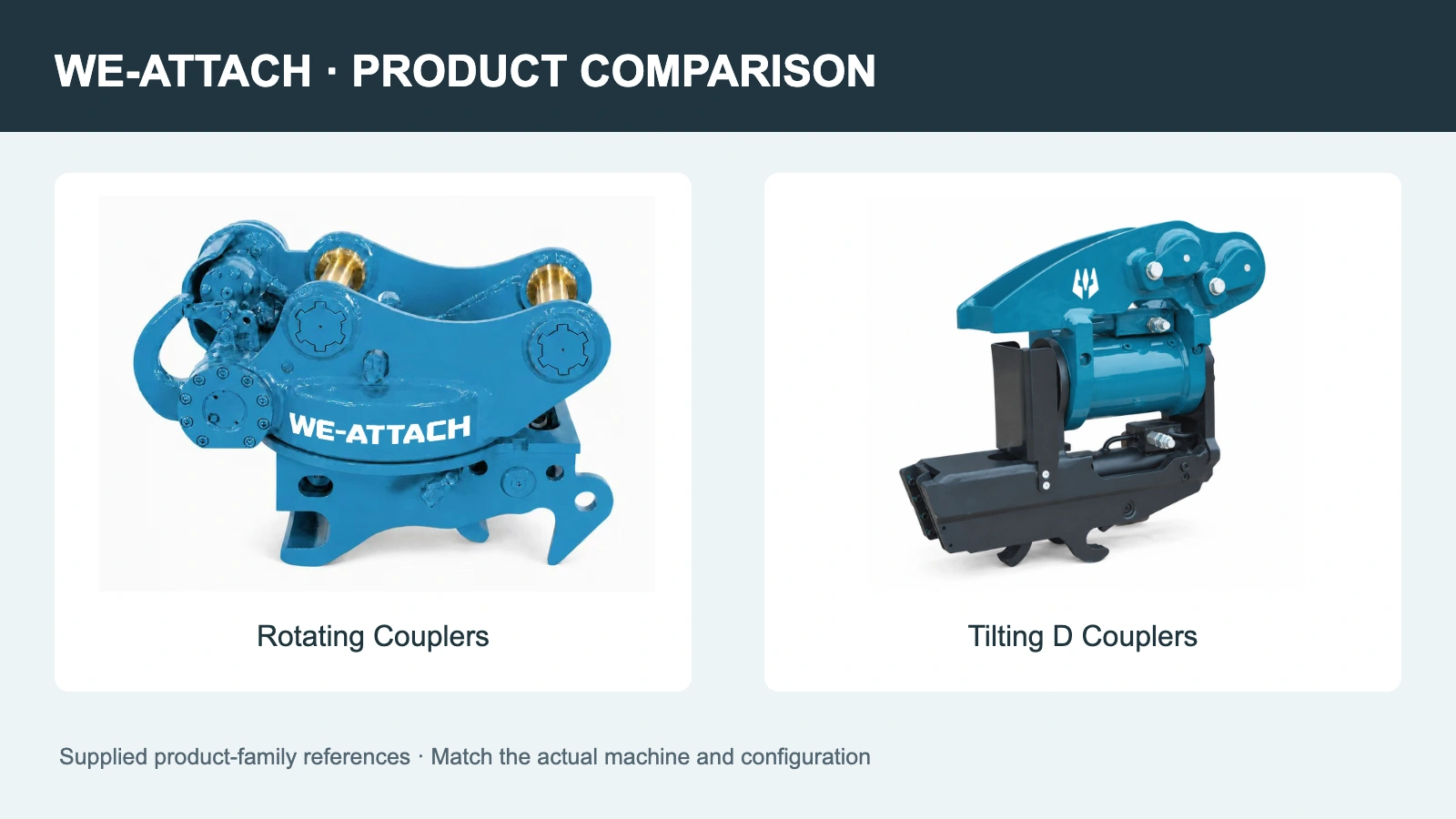
Use this guide to organize the supplied product information around the purchasing task. The exact model, machine and approved configuration remain part of project review.
Choose the movement
A rotary coupler changes the tool orientation through the 360-degree rotation described in the R-series source. A tilting coupler changes the tool angle within its model-specific tilt range. These are different motions; neither label alone establishes a tiltrotator.
Compare the circuits
The R-series table separates rotation-motor and coupling-cylinder flow/pressure. WTD and WTS tables separate the tilt/swing-cylinder arrangement. Do not treat a motor-flow value as an approved swivel-joint flow capacity for another attachment.
Keep the tool and task together
State the required tool direction/angle, working envelope, upper and lower interfaces, machine circuit and attached tool. Compare the specific WRQ, WTD or WTS model with its drawing and documents.
Choose a next step
Open the rotating, tilting D or tilting S type pages to compare source parameters and models. Request written confirmation of the complete tool/coupler/machine configuration.
Source and document traceability
Catalogue transcription for preliminary review. Confirm the applicable configuration and current approved revision before order.
- Quick Coupler Selection Guide ↗ · PDF physical page 8
- Quick Coupler Selection Guide ↗ · PDF physical page 9
- Quick Coupler Selection Guide ↗ · PDF physical page 10